Asia
 Afghanistan
 Armenia
 Azerbaijan
 Baharain
 Bangladesh
 Bhutan
 Brunei
 Cambodia
 China
China Hong Kong
 Cyprus
 East Timor
 Georgia
 India
India Indonesia
 Iran
Iran Iraq
Iraq Israel
 Japan
Japan Jordan
 Kazakhstan
 Kuwait
 Kyrgystan
 Laos
Laos Lebanon
 Maldives
 Mongolia
 Myanmar
 Nepal
Nepal North Korea
 South Korea
 Oman
Oman Pakistan
 Palestine
 Philippines
 Qatar
Qatar Russia
 Saudi Arabia
 Singapore
 Sri Lanka
 Syria
Syria Taiwan
 Tajikistan
 Thailand
 Turkey
 Turkmenistan
 United Arab Emirates
 Uzbekistan
 Vietnam
 Yemen
YemenAtlas
Worldmap
Earth
Making of World Map
World Map
Physical World Map
Political World Map
World Outline Map
Symbol of geography
Tool of map making
Air Route
Agriculture map
Annual Rain fall
Big Business
Continents Map
Earthquake danger zone map
Fisheries
Forest Map
Geology & Soil
Global Warming
Gold mine map
Hotels of World
Language
Literacy
National Parks and wirldlife
Natural Resources
Sea Route
Thematic maps
Temperature and Pressure
World rivers maps
University of World
World Newspapers
World Climate
World Environmental issues
World endangered species
Water
Others
History of World Map
America
Balkan States Map
Baltic States Map
Birds populated areas
Bio-geographical regions or Biomes
Central America Political Map
Commonwealth States map
Desert Map
Indus Valley Civilization (Harappan)
Language Stats
Mountain Range Map
Pacific Ocean Map
Tiger Population map
Sea Animals
Top Ten Countries
UK Political Map
Wildlife Density
7 wonders of the world
Where is?
Where is Asia?
Jordan
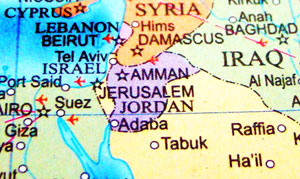
Jordan traces its origin to the semi-autonomous region of Transjordan which was carved out of the Palestine mandate by the UK. The area gained independence form the British in 1946 and came to be called Jordan in 1950.
Though a small country, Jordan has played an important role in the tumultuous politics of Middle East. A key ally of the US, it is one of the two Arab countries to be on good terms with Israel.
The desert kingdom has been ruled for its most part by King Hussein (1953-99). A pragmatic leader with great foresight, he ruled Jordan for 46 years. He tackled dexterously the pulls and pressures of international politics while introducing parliamentary elections in 1989. He made peace with Israel in 1994. After his death in 1999, he was succeeded by his son of King Abdallah II who has embarked on an aggressive policy of aggressive policy of economic reform.
Travel overview
Though to a general observer, Middle East come across a troubled region.
But Jordan has succeeded in remaining immune from the trouble. The
country is home to a diverse landscape that varies from high hills
to flat deserts. Well known for its ancient cities and archeological
sites, the country has lots to offer to the tourists. Roman amphitheater
in the capital city of Amman is spectacular.
Petra, an ancient Arab city rediscovered in the 19th century is famous for its the huge amphitheater. In the country’s southwest part is Aqabah, famous for its excellent beaches. Lying along the Gulf of Aqaba the place offers what is considered to be some of the best diving in the globe Azraq Wetland Wildlife Reserve is a must see for wildlife enthusiast.
You cannot remain but impressed with the ruins of a Triumphal Arch and Hippodrome in the Greco-Roman city of Jerash. The ruins at Umm Qais, the hilltop castle of Qalaat-al-Rabadh at Pella are other tourist attractions in Jordan. The Dead Sea and the breathtaking desert scenery at Wadi Rum, are not to be missed. Crusader Castle and Jebel-al-Qala'a (fortress) offer a wealth of historical sights to explore.
For outdoor activities Jordan is second to none in the world.
Capital: Amman
Location: Middle East, northwest of Saudi Arabia
Climate: mostly arid desert,
Total Area: 92,300 sq km
Total Population: 6,053,193
Population Growth Rate: 2.412%
Sex Ratio: 1.102 male(s)/female
Literacy: 89.9%
Ethnic Groups: Arab, Circassian, Armenian
Irrigated land: 750 sq km
Languages: Arabic, English
Time Zone: UTC+2
Currency: Jordanian dinar (JOD)
Neighbouring countries: Iraq, Israel, Saudi Arabia, Syria, West Bank
Type of govt.: constitutional monarchy
Head of Govt.: Prime Minister Marouf al-Bakhit
Major Political Parties: al-Ahd Party; Arab Islamic Democratic Movement
, Arab Land Party , Arab Socialist Ba'th Party , Ba'th Arab Progressive
Party , Freedom Party, Future Party, Islamic Action Front or IAF ,
Islamic Center Party, Jordanian Arab Ansar Party, Jordanian Arab New
Dawn Party, Jordanian Arab Party, Jordanian Citizens' Rights Movement,
Jordanian Communist Party, Jordanian Communist Workers Party, Jordanian
Democratic Left Party, Jordanian Democratic Popular Unity Party, Jordanian
Generations Party , Jordanian Green Party , Jordanian Labor Party
, Jordanian Peace Party, Jordanian People's Committees Movement, Jordanian
People's Democratic Party , Jordanian Rafah Party, Jordanian Renaissance
Party, Mission Party, Nation Party , National Action Party, National
Constitutional Party , National Popular Democratic Movement , Progressive
Party
Participation in International Organizations: ABEDA, CAEU, AFESD,
AMF, FAO, G-77, ICAO, ICC, IAEA, IBRD, ICCt, ICRM, IDA, IFRCS, ILO,
IDB, IFAD, IFC, IMF, IMO, IPU, ISO, ITU, Interpol, IOC, IOM, ITUC,
LAS, MONUC, OIC, ONUB, MIGA, MINUSTAH, OPCW, PCA, UN, UNIDO, UNMEE,
UNCTAD, UNESCO, UNHCR, UNMIL, UNMIS, UNOCI, UNOMIG, WFTU, WHO, UNRWA,
UNWTO, UPU, WCO, WIPO, WMO, WTO
Major Agricultural Products: citrus, olives; sheep, poultry, tomatoes,
cucumbers, stone fruits, strawberries and dairy
Natural Resources & Minerals: phosphates, shale oil, potash
Industry & Transport: fertilizers, pharmaceuticals, clothing,
phosphate mining, petroleum refining, cement, light manufacturing,
potash, inorganic chemicals, tourism
Airports: 17
Railways: 505 km
Roadways: 7,500 km
Major Trade Partners: US, Iraq, India, Saudi Arabia, Syria, Saudi
Arabia, China, Germany
Exports: $4.798 billion
Imports: $10.42 billion
