Asia
 Afghanistan
 Armenia
 Azerbaijan
 Baharain
 Bangladesh
 Bhutan
 Brunei
 Cambodia
 China
China Hong Kong
 Cyprus
 East Timor
 Georgia
 India
India Indonesia
 Iran
Iran Iraq
Iraq Israel
 Japan
Japan Jordan
 Kazakhstan
 Kuwait
 Kyrgystan
 Laos
Laos Lebanon
 Maldives
 Mongolia
 Myanmar
 Nepal
Nepal North Korea
 South Korea
 Oman
Oman Pakistan
 Palestine
 Philippines
 Qatar
Qatar Russia
 Saudi Arabia
 Singapore
 Sri Lanka
 Syria
Syria Taiwan
 Tajikistan
 Thailand
 Turkey
 Turkmenistan
 United Arab Emirates
 Uzbekistan
 Vietnam
 Yemen
YemenAtlas
Worldmap
Earth
Making of World Map
World Map
Physical World Map
Political World Map
World Outline Map
Symbol of geography
Tool of map making
Air Route
Agriculture map
Annual Rain fall
Big Business
Continents Map
Earthquake danger zone map
Fisheries
Forest Map
Geology & Soil
Global Warming
Gold mine map
Hotels of World
Language
Literacy
National Parks and wirldlife
Natural Resources
Sea Route
Thematic maps
Temperature and Pressure
World rivers maps
University of World
World Newspapers
World Climate
World Environmental issues
World endangered species
Water
Others
History of World Map
America
Balkan States Map
Baltic States Map
Birds populated areas
Bio-geographical regions or Biomes
Central America Political Map
Commonwealth States map
Desert Map
Indus Valley Civilization (Harappan)
Language Stats
Mountain Range Map
Pacific Ocean Map
Tiger Population map
Sea Animals
Top Ten Countries
UK Political Map
Wildlife Density
7 wonders of the world
Where is?
Where is Asia?
Iraq
Iraq | Whre is Iraq? | Iraq Flag | Map Iraq
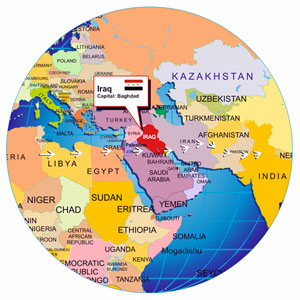
Iraq is the cradle of Mesopotamian civilization. The country never ceases to be in the limelight. Today, Iraq is a polyglot nation. Once the part of the Ottoman Empire, the country came under the British control during the course of World War I. However it achieved its independence in 1932. Though the country became a "republic", the country was ruled by a number of military strongmen. Saddam Hussein was last such ruler. The country entered into an eight-year war (1980-88) with Iran that proved inconclusive and costly.
In 1990, Iraq embarked on an ambitious policy of aggression by seizing Kuwait, but was forced to liberate the country after the intervention by US-led, UN coalition forces during the Gulf War of January-February 1991. As Iraq was to destroy all weapons of mass destruction under the resolution passed by UN Security Council (UNSC) and also to allow UN verification inspections. But Iraq adamantly refused to do so. This resulted in the US-led invasion of Iraq in March 2003 that ousted Saddam Husayn. Today Iraq is in complete turmoil with bomb blasts taking place almost everyday killing scores of people.
Travel overview
Everybody has heard of Iraq, the land of Euphrates and the Tigris.
These days most people have image of violence in their heads, but
almost everyone who visits the country is surprised at what they find.
The land of the Mesopotamian civilization, Iraq lives up to its fabled
magnificence. A fascination place, it is full of ancient and medieval
cities with religious sites and ancient relics. Here you'll find three
of the Muslim world's most venerated institutions and the ancient
archaeological sites at Babylon, Ur and Nineveh. Arch of Ctesiphon
dating to the 2nd century, the 13th century Palace of Qara Sariai
and the Nabi Jirjis at Mosul are not be missed.
Capital: Baghdad
Location: Middle East, bordering the Persian Gulf, between Iran and
Kuwait
Climate: desert, mild, dry, hot
Total Area: 437,072 sq km
Total Population: 27,499,638
Population Growth Rate: 2.618%
Sex Ratio: 1.024 male(s)/female
Literacy: 74.1%
Ethnic Groups: Arab, Kurdish, Turkoman, Assyrian
Irrigated land: 35,250 sq km
Languages: Arabic, Kurdish, Assyrian, Armenian
Time Zone: UTC+8
Currency: New Iraqi dinar (NID)
Neighbouring countries: Iran, Jordan, Kuwait, Saudi Arabia, Syria,
Turkey
Type of govt.: parliamentary democracy
Head of Govt.: Prime Minister Nuri al-Maliki
Major Political Parties: Assyrian Democratic Movement, Badr Organization
, Constitutional Monarchy Movement or CMM , Da'wa al-Islamiyya Party
, General Conference of Iraqi People , Independent Iraqi Alliance
or IIA , Iraqi Communist Party , Iraqi Front for National Dialogue
, Iraqi Hizballah , Iraqi Independent Democrats or IID ,Iraqi Islamic
Party or IIP , Iraqi National Accord or INA , Iraqi National Congress
or INC , Iraqi National Council for Dialogue or INCD , Iraqi National
Unity Movement or INUM , Islamic Action Organization or IAO , Jama'at
al Fadilah or JAF , Kurdistan Democratic Party or KDP , Kurdistan
Islamic Union , National Reconciliation and Liberation Party , Patriotic
Union of Kurdistan or PUK , Sadrist Trend, Supreme Council for the
Islamic Revolution in Iraq or SCIRI
Participation in International Organizations: AMF, CAEU, ABEDA, AFESD,
FAO, G-77, ICAO, ICRM, IAEA, IBRD, IDA, IDB, IFRCS, ILO, IFAD, IFC,
IMF, IMO, ISO, ITU, LAS, Interpol, IOC, NAM, OAPEC, PCA, UN, UNCTAD,
OIC, OPEC, UNESCO, UNIDO, UNWTO, WFTU, WHO, UPU, WCO, WIPO, WMO,
Major Agricultural Products: wheat, rice, barley, cotton, cattle,
sheep, vegetables, dates, poultry
Natural Resources & Minerals: petroleum, natural gas, sulfur,
phosphates
Industry & Transport: petroleum, chemicals, construction materials,
textiles, leather, food processing, fertilizer
Airports: 110
Railways: 2,200 km
Roadways:
45,550 km
Waterways: 5,279 km
Major Trade Partners: US, Italy, Spain, Canada, Turkey, Syria and
Jordan
Exports: $32.19 billion
Imports: $20.76 billion
