Africa
 Algeria
 Angola
 Benin
Benin Botswana
 Burkina
 Burundi
 Cameroon
 Cape Verde
 Chad
Chad Comoros
 Congo
Congo Cote D'ivore
 Djibouti
 Egypt
Egypt Equatorial Guinea
 Eritrea
 Ethiopia
 Gabon
Gabon Gambia
 Ghana
Ghana Guinea
 Guinea-Bissau
 Kenya
Kenya Lesotho
 Liberia
 Libya
Libya Madagascar
 Malawi
 Mali
Mali Mauritania
 Mauritius
 Morocco
 Mozambique
 Namibia
 Niger
Niger Nigeria
 Rwanda
 Sao Tome & Principe
 Senegal
 Seychelles
 Sierra Leone
 Somalia
 South Africa
 Swaziland
 Tanzania
 Togo
Togo Tunisia
 Uganda
 Zambia
 Zimbabwe
Otherr African Maps
Annual Rainfall and Monsoon Africa
Temperature and Pressure Africa
Precipitation and winds Africa
Kenya
Kenya | Kenya Map | Where is Kenya
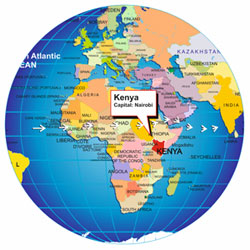
Located on the equator on the east coast of Africa, Kenya is known
to have protohumans roaming its territory some 20 million years ago.
Rightly so, the country is often referred to as "the cradle of
humanity".
Kenya declared its independence from Britain in 1963 under the leadership
of its charismatic icon Jomo Kenyatta. He was succeeded in 1978 by
President Daniel arap Moi, who ruled the country for 24 years. During
the 70s and 80s the ruling Kenya African National Union, KANU, was
the sole legal political party in the country.
MOI acceded to the violent unrest in the country as well as international
pressure and restored the multi-party politics in late 1991. However
Kanu rule ended only in 2002 when the opposition candidate Mwai Kibaki
defeated the ruling dispensation and became president
Travel overview
History weighs heavily on Kenya. To enjoy the African safari experience
it is the ultimate destination. It is home to Mount Kenya, second
highest mountain in Africa. The world-famous national parks including
Samburu Game Reserve, Hell's Gate National Park and Masai Mara National
Park are abundant in the country, not to mention the white sand beaches.
The capital city of Nairobi is a fascinating place. The UN's fourth
"World Centre", the city is famous for national Museum.
Travel attractions in Kenya include the coastal cities of Mombasa
and Lamu. The archeological sites of Gede and Hyrax Hill are well
worth a visit. Amboseli National Park is a game viewing paradise where
you will find elephant herds passing before the majestic backdrop
of Mt. Kilimanjaro.
To the west of the country is located the stunning Great Rift Valley
crammed with lakes teeming with a variety of birdlife.
Capital: Nairobi
Location: Eastern Africa
Climate: Tropical, arid
Total Area: 582,650 sq km
Total Population: 36,913,721
Population Growth Rate: 2.799%
Sex Ratio: 1.004 male(s)/female
Literacy: 85.1%
Ethnic Groups: Kikuyu, Luhya, Luo , Kalenjin, Kamba , Kisii , Meru
, Asian, European and Arab
Irrigated land: 1,030 sq km
Languages: English, Kiswahili, indigenous languages
Time Zone: UTC+3
Currency: Kenyan shilling (KES)
Neighbouring countries: Ethiopia, Somalia, Sudan, Tanzania, Uganda
933 km
Type of govt.: republic
Head of Govt.: President Mwai Kibaki
Major Political Parties: Forum for the Restoration of Democracy-Kenya
or FORD-Kenya , Forum for the Restoration of Democracy-People or FORD-People
, Kenya African National Union or KANU , National Rainbow Coalition-Kenya
or NARC-K , Orange Democratic Movement-Kenya or ODM-Kenya
Participation in International Organizations: ACP, EADB, FAO, AfDB,
AU, C, COMESA, G-15, G-77, ICRM, IDA, IFAD, IFC, IAEA, IBRD, ICAO,
ICCt, IFRCS, IGAD, Interpol, IOC, IOM, ILO, IMF, IMO, IPU, ISO, ITU,
MONUC, NAM, ONUB, ITUC, MIGA, MINURSO, OPCW, PCA, UNHCR, UNIDO, UNMEE,
UNMIL, UN, UNCTAD, UNESCO, UNMIS, UNOCI, WHO, WIPO, WMO, WTO, UNWTO,
UPU, WCO,
Major Agricultural Products: tea, sugarcane, fruit, vegetables, coffee,
corn, wheat, pork, poultry, dairy products, beef, eggs
Natural Resources & Minerals: limestone, soda ash, salt, zinc,
diatomite, gypsum, gemstones, fluorspar, wildlife, hydropower
Industry & Transport: plastic, furniture, clothing, soap, batteries,
textiles, cigarettes, flour, agricultural products, aluminum, steel,
lead, horticulture, oil refining, cement, commercial ship repair,
tourism
Airports: 225
Railways: 2,778 km
Roadways: 63,265 km
Waterways: Lake Victoria system
Major Trade Partners: Uganda, UK, US, Netherlands, Tanzania, Pakistan,
UAE, India, Saudi Arabia, South Africa, China, Japan
Exports: $3.614 billion
Imports: $6.602 billion
